
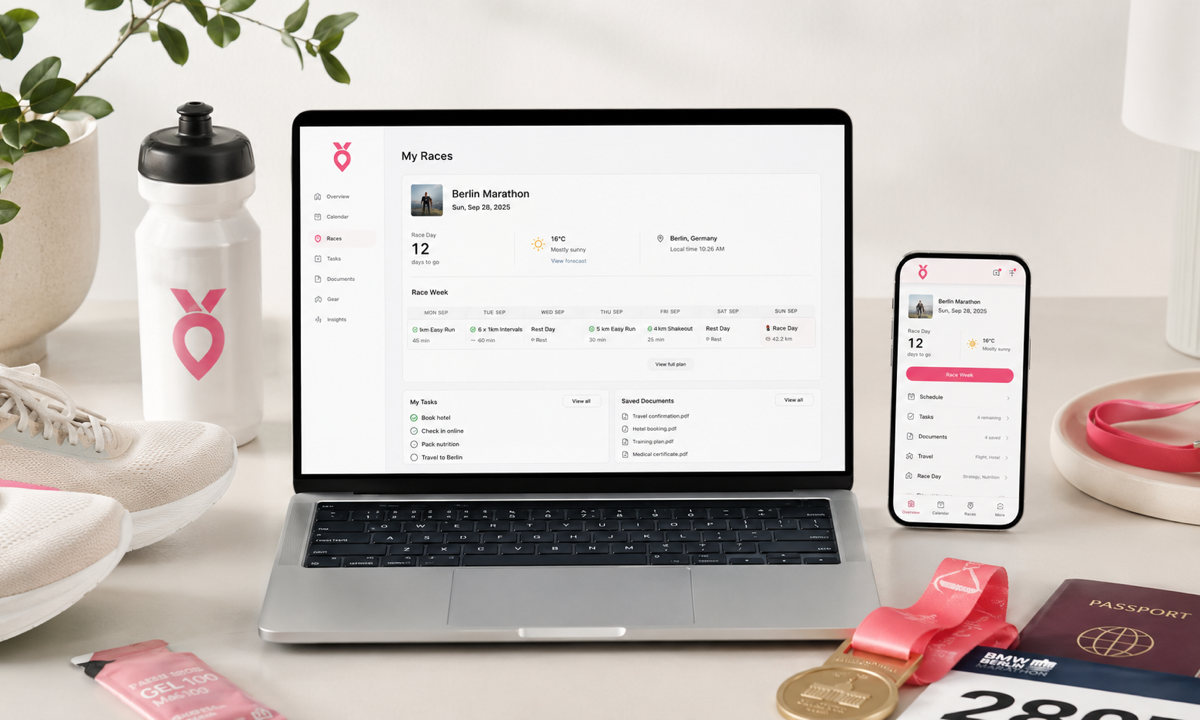
Race week can make even experienced runners feel unprepared.
The training has already been done. The hardest sessions are behind you. The race is close enough to feel real, but there are still decisions everywhere.
What should you run this week?
What should you eat?
When should you pick up your bib?
What should go in the bag?
What happens if the weather changes?
Where is the start area?
How early should you arrive?
Where did that confirmation email go?
A good race week checklist does not make the race more complicated. It does the opposite. It removes avoidable stress so the runner can focus on arriving calm, prepared and ready to execute.
This guide covers the practical things to check during race week, from training and pacing to travel, kit, documents, fueling and race morning.
What race week is really for
Race week is not the time to build fitness.
That part is already done.
The goal of race week is to protect the work already completed, reduce stress, sharpen the plan and arrive at the start line with as few unanswered questions as possible.
For most runners, that means three things.
First, do enough running to stay loose, but not so much that fatigue builds.
Second, make the practical decisions early.
Third, avoid introducing anything new unless there is a clear reason.
Race week should create clarity.
It should not become a final attempt to fix the entire training block.
Seven days before the race
One week out, the race is close enough that planning needs to become specific.
This is the right time to review the full race setup.
Check the race website and official emails. Confirm the start time, wave or corral information, bib pickup details, bag drop rules, aid station information, course map, transport advice and any cut-off times.
Do not assume the details are the same as last year.
Races change start areas, pickup locations, routes, bag policies and wave schedules. A few minutes of checking can prevent a lot of confusion later.
This is also the time to review your goal.
Ask yourself:
Does the goal still match the training?
Is the target pace realistic?
Do you need an A, B and C goal?
Are there course or weather factors to consider?
What would a successful race look like if conditions are not perfect?
A realistic race goal should be based on the evidence you have now, not only the goal you chose months ago.
Six days before the race
Six days out, focus on logistics.
If the race involves travel, confirm every booking. Check trains, flights, hotels, parking, public transport, arrival times and check-in details.
If you are staying away from home, look at the route from your accommodation to the start area. Do not wait until race morning to discover that the start is further away than expected.
Useful things to confirm include:
- Hotel or accommodation address
- Check-in and check-out times
- Transport to the race start
- Transport from the finish area
- Parking rules
- Public transport tickets
- Breakfast options
- Restaurant or food options
- Distance to bib pickup
- Distance to bag drop
- Post-race meeting point
Destination races need more planning because small problems can become harder to solve away from home.
For local races, logistics still matter. You need to know how long it takes to get there, where to park, where to enter the start area and what time you need to leave home.
Five days before the race
Five days out, start thinking about kit.
Do not leave the kit check until the night before. That is when missing safety pins, dead watch batteries, forgotten socks or bad weather changes become stressful.
Lay out the full race setup.
Include everything you expect to wear and carry.
Race kit should include:
- Race shoes
- Race socks
- Shorts or tights
- Singlet, T-shirt or top
- Sports bra if needed
- Watch
- Heart rate strap if used
- Race belt or pins
- Cap or sunglasses
- Gloves or arm sleeves if needed
- Warm layer for before the start
- Change of clothes for after the finish
- Blister protection if normally used
- Anti-chafe product if normally used
Do not race in brand new shoes, socks or clothing unless there is no alternative. Race day is not the best time to discover that something rubs, slips, overheats or feels wrong.
The best kit is usually boring because it has already been tested.
Four days before the race
Four days out, review fueling and hydration.
For longer races, especially half marathons, marathons and trail events, fueling should not be improvised.
Decide what you will take, when you will take it and how you will carry it.
A simple fueling checklist includes:
- Gels, chews, drink mix or other fuel
- How many servings you need
- When to take each serving
- Whether to take fuel with water
- What the race provides at aid stations
- Whether you have tested the same products before
- How to carry fuel comfortably
- What to eat before the race
- What to avoid before the race
If your stomach is sensitive, keep the plan simple and familiar.
Race week is not the time to experiment with new gels, new caffeine products, unfamiliar breakfasts or aggressive carb-loading strategies you have never tried before.
Hydration also needs balance. Drinking too much can be a problem, just like drinking too little. The practical approach is to arrive well hydrated without forcing extreme changes.
Pay attention to normal signals. Pale urine, stable energy and no excessive thirst are usually better signs than trying to hit an arbitrary number.
Three days before the race
Three days out, organize your documents and race information.
This is one of the most overlooked parts of race week.
Many races rely on digital confirmations, QR codes, emails, IDs, medical certificates, registration numbers, apps or pickup instructions. These are often scattered across inboxes, websites and attachments.
Put everything important in one place.
Save or screenshot:
- Race confirmation
- Bib pickup QR code
- Registration number
- Start time
- Wave or corral
- Race guide
- Course map
- Aid station map
- Bag drop information
- Emergency contact details
- Transport tickets
- Hotel confirmation
- Travel booking
- Insurance details if relevant
- Medical certificate if required
- Post-race meeting location
Do not rely on having perfect mobile signal at the expo, start area or finish zone.
Big events can overload networks. Batteries drain. Apps log out. Emails become hard to find when stress is high.
Saving key information offline is one of the easiest ways to reduce race-week friction.
Two days before the race
Two days out, keep things calm.
At this point, the goal is to avoid unnecessary stress and unnecessary changes.
Check the weather forecast, but do not obsess over it. Weather matters, but checking it every hour rarely improves the plan.
Instead, decide what changes are actually needed.
If it may rain, plan the layers and post-race clothes.
If it may be hot, adjust pace expectations and hydration.
If it may be cold at the start, plan a throwaway layer or warm clothing.
If it may be windy, think about effort rather than perfect pace.
Race conditions are part of the race. The goal is not to control them. The goal is to respond calmly.
Two days out is also a good time to reduce unnecessary walking or standing. Expos can be exciting, but spending hours on your feet is not ideal before an important race.
Pick up the bib, enjoy the atmosphere, then get off your feet.
The day before the race
The day before the race should be simple.
Your main tasks are to finalize the kit, confirm timing and avoid last-minute decisions.
Prepare everything before bedtime.
Lay out race clothes.
Attach bib if you already have it.
Charge your watch.
Charge your phone.
Prepare breakfast.
Pack your race bag.
Set alarms.
Check transport.
Confirm when you need to leave.
Save key documents offline.
Review the race plan once.
This is also the time to decide what not to do.
Do not panic train.
Do not try new shoes.
Do not eat unusual food.
Do not change the goal because of nerves.
Do not spend hours scrolling race predictions.
Do not overpack so much that you cannot find anything.
A short shakeout run can be useful for some runners, but it should feel easy and familiar. It should not become a test of fitness.
The day before the race is about confidence, not proof.
Race morning
Race morning should follow a plan that is already decided.
The fewer decisions you need to make, the better.
A simple race morning plan should include:
- Wake-up time
- Breakfast time
- What to eat and drink
- Bathroom timing
- When to get dressed
- When to leave
- How to get to the start
- When to arrive
- Bag drop timing
- Warm-up timing
- Final toilet stop
- When to enter the start area
- First kilometer strategy
For many runners, arriving early is better than arriving rushed. But arriving too early can also mean standing around for a long time, especially in cold or wet weather.
The right timing depends on the race size, transport, bag drop, toilets and start waves.
For large races, plan more time than you think you need.
For smaller local races, the morning can often be simpler.
The final hour before the start
The final hour is where nerves usually rise.
This is normal.
The goal is not to eliminate nerves. The goal is to keep them from controlling the race.
Use the final hour for simple actions.
Drop your bag.
Use the toilet.
Start sipping if needed.
Take final fuel if planned.
Warm up if appropriate.
Check shoes and laces.
Move toward the start area.
Remind yourself of the first part of the plan.
The most important thing to remember is this: the race is not won in the first kilometer, but it can become much harder there.
Many runners start too fast because they feel fresh, excited or crowded by others.
A good race plan should make the start feel almost too controlled.
That is usually a good sign.
What to include in your race plan
A race plan does not need to be complicated.
It should be clear enough to remember when the race gets hard.
Include:
- Your A, B and C goals
- Target pace or target effort
- First section strategy
- Middle section strategy
- Final section strategy
- Fueling timing
- Hydration approach
- Weather adjustment
- Course notes
- Mantra or mental cue
- What to do if things feel too hard early
- What to do if things feel good late
For example, a marathon plan may say:
Start the first 5 kilometers slightly slower than goal pace.
Settle into goal effort from 5 to 30 kilometers.
Fuel every 30 minutes.
Do not judge the race before halfway.
If strong at 32 kilometers, gradually increase effort.
If the weather is hot, race by effort instead of pace.
That is simple, but useful.
Packing checklist for race week
A packing checklist is especially helpful for destination races, but it can also help for local races.
Basic race items:
- Shoes
- Socks
- Race kit
- Watch
- Phone
- Bib
- Pins or race belt
- Fuel
- Water bottle if used
- Headphones if allowed
- Sunglasses
- Cap
- Gloves
- Warm layer
- Rain jacket if needed
- Post-race clothes
- Sandals or comfortable shoes
- Toiletries
- Medication if needed
- Blister protection
- Anti-chafe product
- Documents and logistics:
- Race confirmation
- ID
- Travel tickets
- Hotel booking
- Insurance details
- Emergency contact
- Payment card
- Cash if needed
- Phone charger
- Power bank
- Race guide
- Start area map
- Finish area map
For destination races, bring essential race items in hand luggage where possible. Lost luggage is rare, but losing race shoes before a goal race is a problem worth avoiding.
Food checklist
Race-week food should be familiar.
The exact approach depends on the race distance, personal needs and previous experience, but the principle is simple.
Do not surprise your stomach.
Useful items to plan:
- Normal breakfast foods
- Pre-race snacks
- Race fuel
- Electrolytes if used
- Post-race snack
- Water bottle
- Food for travel
- Restaurant options
- Backup food if plans change
If you are traveling, check food options near your accommodation. The night before a race is not the best time to discover that every restaurant is fully booked or that nothing familiar is nearby.
For big races, book dinner in advance if needed.
Common race-week mistakes
Most race-week mistakes are avoidable.
The most common ones include:
- Doing too much training because of nerves
- Trying new food or fuel
- Buying new race shoes too late
- Ignoring weather until race morning
- Not reading the race guide
- Forgetting bib pickup details
- Arriving too late
- Starting too fast
- Standing too much at the expo
- Not saving documents offline
- Making the goal too rigid
- Skipping breakfast because of nerves
- Overthinking every small feeling
Race week often magnifies doubt.
A small ache feels serious. A slow easy run feels like lost fitness. A bad night of sleep feels like disaster. A weather forecast feels personal.
Most of the time, these are normal race-week reactions.
The checklist helps separate real problems from noise.
What not to worry about too much
Not everything in race week deserves attention.
One bad sleep two nights before the race does not ruin everything.
A short easy run that feels heavy does not mean fitness disappeared.
Feeling nervous is not a bad sign.
Weather may change again.
Other runners' plans do not need to become your plan.
A race week checklist is useful because it gives you something practical to focus on. Once the important items are covered, there is no need to keep checking everything again and again.
Preparation should create calm, not more noise.
The short version
For a simple race week, focus on these essentials.
Seven days out: review race information and goal.
Six days out: confirm travel and logistics.
Five days out: check race kit.
Four days out: finalize fueling and hydration.
Three days out: save documents and race details offline.
Two days out: adjust for weather and reduce stress.
One day out: prepare everything before bedtime.
Race morning: follow the plan, start controlled and avoid last-minute decisions.
That is enough for most runners.
Final thought
Race week should not be chaos.
The training has already created the foundation. The checklist protects it.
A clear plan helps runners arrive at the start line with less stress and more control. It does not guarantee the perfect race, but it reduces the number of things that can go wrong before the race even begins.
The best race weeks are often quiet.
Everything is checked.
The kit is ready.
The documents are saved.
The plan is clear.
The first kilometer is controlled.
The runner knows what to do.
That is the point of a good race week checklist.
Not to overthink the race.
To make space for the race itself.