
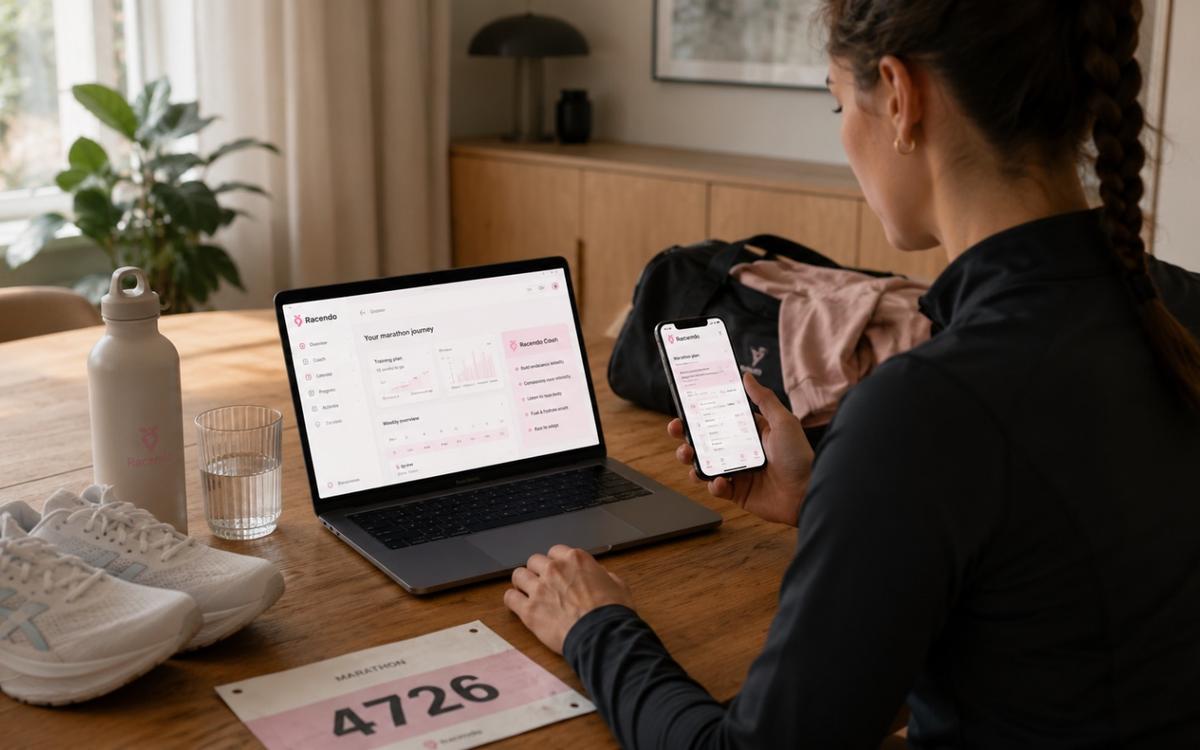
Signing up for your first marathon is a big moment.
At first, it's exciting. There's a race on the calendar. There's a distance to respect. There's a goal that suddenly feels real.
Then the questions start.
How long should the training plan be?
What pace should feel realistic?
How many long runs are enough?
What should you eat during the race?
Where do you pick up the bib?
How early should you arrive?
What should you pack?
What happens if the weather changes?
A first marathon can feel overwhelming because it's not only about running 42.2 kilometers. It's also about managing the months around it.
Training matters, but it's not the full picture.
A good first marathon plan should help you prepare your body, your race day, your travel, your kit, your fueling, your budget and your expectations.
This guide walks through the practical details that first-time marathon runners often miss.
Start with the reason
Before choosing a time goal, start with the reason.
Why this marathon?
For a first marathon, that question matters more than people think.
Some runners want to finish strong. Some want to raise money for charity. Some want to prove something to themselves. Some are joining friends. Some want to experience a major city marathon. Some are building toward a bigger race goal later.
The reason helps shape the plan.
If the goal is to finish with control, the training and race plan should support patience and consistency.
If the goal is a specific time, the plan needs more structure around pace, long runs and race-specific sessions.
If the goal is to enjoy the experience, the plan should leave room for confidence, recovery and a race weekend that doesn't feel like a military operation.
A first marathon is already a big achievement.
The goal should support the experience, not crush it.
Choose the right marathon
Not every marathon is a good first marathon.
Some races are easier to manage than others. A flat local race can be simpler than a major international race. A big city marathon can offer amazing atmosphere, but it may also involve travel, crowds, expos, complex start areas and more logistics.
When choosing your first marathon, look at more than the name.
Useful things to check:
Course profile
Expected weather
Start time
Number of runners
Travel requirements
Bib pickup rules
Cut-off time
Aid stations
Crowd support
Medical support
Accommodation availability
Cost of the full weekend
A famous race can be worth the effort, but it's still worth knowing what you're signing up for.
The best first marathon is not always the biggest one. It's the one that gives you enough time to train, enough support on the day and a race environment that matches your goal.
Give yourself enough time
A first marathon needs time.
Many runners use training plans between 16 and 24 weeks, depending on their starting point. Some need longer. The right timeline depends on current fitness, injury history, running experience and how consistently the runner can train.
The biggest mistake is trying to rush the process.
A marathon training block needs enough time to build gradually. That matters because the distance is demanding, and the body needs time to adapt.
Before starting, ask:
Can I already run consistently?
How many days per week can I realistically train?
Do I have enough time for long runs?
Are there holidays, work peaks or travel periods in the plan?
Have I had recent injury problems?
Do I need a base-building phase before marathon training starts?
A marathon plan that looks good on paper is only useful if it fits real life.
It's better to choose a realistic plan that can be followed than an ideal plan that collapses after three weeks.
Set a first marathon goal that makes sense
A first marathon goal should be motivating, but it should also be honest.
For many first-time marathon runners, the best first goal is to finish well.
That doesn't mean the goal is easy. It means the focus is on preparing properly, pacing smartly and getting to the finish with control.
Time goals can work, especially for runners with experience at shorter distances. But they should be based on evidence, not only hope.
A good goal structure is:
A goal: the ambitious result if training and race day go well
B goal: the strong, realistic result if the day is solid
C goal: the outcome that still makes the race meaningful if things get hard
For a first marathon, that could look like this:
A goal: finish under 4:30
B goal: finish feeling in control
C goal: keep moving and complete the race
This gives the day more flexibility.
The marathon is long. Weather, stomach, pacing, sleep and nerves can all affect the result. Having more than one goal helps avoid all-or-nothing thinking.
Build the training around consistency
First marathon training is not about one heroic workout.
It's about stacking weeks.
The long run gets a lot of attention, and it should. But consistency across the full training block matters just as much.
A useful first marathon training week often includes:
Easy runs
One longer run
Rest or recovery days
Optional quality session
Strength or mobility work
Enough easy running to build endurance
Enough recovery to absorb the work
The exact structure depends on the runner.
What matters is that the plan can be repeated.
If every week feels like a battle, the plan may be too aggressive. If every run is too hard, recovery will suffer. If long runs keep being skipped, the marathon will feel much harder than it needs to.
Consistency builds confidence.
It also gives better information about what race day may look like.
Respect the long run
The long run is one of the most important parts of first marathon preparation.
It teaches the body to spend more time on feet. It helps runners practice pacing, fueling, clothing, shoes and mental patience. It also shows how recovery is progressing.
But long runs should be built carefully.
They are not supposed to become a weekly race.
Useful long-run principles:
Build gradually
Keep most long runs controlled
Practice fueling during longer runs
Test race shoes and socks
Avoid turning every long run into a time trial
Notice how recovery feels afterward
Learn what pace feels sustainable
For a first marathon, long runs should create confidence, not fear.
One bad long run does not ruin the plan. But repeated long-run struggles are useful information. They may mean the pace is too fast, recovery is too weak, fueling needs work or the plan is too demanding.
The long run should prepare the race, not exhaust the runner before the race arrives.
Practice fueling early
Fueling is one of the most common first marathon mistakes.
Many runners train the legs but forget to train the stomach.
A marathon usually requires fuel during the race. The body needs energy to keep moving, especially after the first half. Waiting until the final 10 kilometers to think about fueling is too late.
Fueling should be practiced in training.
Start with simple questions:
What fuel will I use?
How often will I take it?
Do I need water with it?
Does my stomach tolerate it?
Can I carry it comfortably?
Does the race provide the same product?
What's the backup if I drop something?
Do not try a new gel, drink mix or caffeine strategy for the first time on race day.
The best race-day fueling plan is one you've already tested.
Plan the race weekend cost
The entry fee is only one part of the marathon cost.
A first marathon can include travel, accommodation, food, shoes, kit, fuel, race photos, expo purchases, insurance, public transport and recovery items.
That doesn't mean the race has to be expensive. But it helps to see the full picture early.
Common marathon weekend costs include:
Race entry
Travel to the city
Accommodation
Local transport
Food before and after the race
Race fuel
Shoes and kit
Bag drop or locker fees if relevant
Insurance for travel races
Race photos or merchandise
Recovery items
Planning costs early reduces stress later.
It also helps you decide which races are worth traveling for, where to save money and what needs to be booked before prices rise.
A first marathon should feel exciting, not financially confusing.
Keep race documents in one place
Race documents are easy to underestimate.
They often live across emails, PDFs, race websites, apps and booking platforms. That works until race week, when the runner suddenly needs everything quickly.
Keep key documents together.
Save:
Race confirmation
Bib pickup QR code
Registration number
Race guide
Start time
Wave or corral information
Bag drop details
Course map
Aid station map
Travel tickets
Hotel booking
Emergency contact details
Medical certificate if required
Insurance details if traveling
Save screenshots too.
Do not rely only on email search or race websites. Big events can overload mobile networks, and race morning is not the best time to find a login link.
Learn the course before race day
You do not need to memorize every turn.
But you should understand the course.
Course knowledge helps with pacing, fueling and expectations. It also helps avoid surprises.
Look for:
Hills
Bridges
Exposed windy sections
Narrow early sections
Cobblestones or uneven surface
Aid station locations
Halfway point
Tough final sections
Supporter-friendly locations
Finish area layout
A flat course and a hilly course require different pacing.
A crowded start may require patience.
A windy section may need effort-based running instead of chasing pace.
A course with late hills should be respected early.
Knowing the course helps you run smarter.
Create a race plan before race week
A first marathon race plan should be simple.
It should not be a 12-page strategy document. It should be a clear guide for what you'll do before and during the race.
Include:
A, B and C goals
Target pace or effort
First 5K strategy
Fueling timing
Hydration approach
Weather adjustment
What to do if the pace feels hard
What to do if you feel strong late
Post-race meeting point
For a first marathon, the first part of the plan is often the most important.
Start controlled.
Many first-time marathon runners lose time later because they gain too much excitement early. The first 5 to 10 kilometers should feel patient. If it feels too easy, that may be exactly right.
The marathon usually begins to ask real questions later.
Save energy for those questions.
Plan race week early
Race week should not become a final scramble.
The goal is to protect the training, organize the practical details and arrive calm.
A simple race-week structure:
Seven days out: review race details and goal
Six days out: confirm travel and logistics
Five days out: check race kit
Four days out: finalize fueling
Three days out: save documents offline
Two days out: adjust for weather
One day out: prepare everything before bedtime
Race morning: follow the plan
This kind of structure reduces decisions.
It also helps stop race nerves from turning into unnecessary changes.
Race week is not the time to prove fitness. It's the time to trust the preparation.
Pack with the race in mind
Packing for a first marathon can feel bigger than expected.
The goal is not to bring everything. It's to bring the items that protect the race experience.
Race essentials:
Race shoes
Race socks
Race kit
Bib
Safety pins or race belt
Watch and charger
Fuel
Anti-chafe product
Blister protection if normally used
Cap or sunglasses if needed
Gloves or arm sleeves if needed
Warm layer for the start
Travel and recovery items:
Dry clothes after the race
Comfortable shoes
Recovery snack
Water bottle
Phone charger
Power bank
Hotel booking
Travel tickets
ID or passport
Toiletries
Medication if needed
If traveling, keep race essentials in hand luggage where possible.
Lost luggage is rare, but it's not worth risking the shoes and kit you've trained in.
Do not change everything at the expo
A marathon expo can be exciting.
It can also be dangerous for decision-making.
There are shoes, gels, clothes, gadgets, recovery tools, supplements and confident people giving advice. It's easy to start doubting what you already planned.
Enjoy the expo, but be careful.
Do not change:
Shoes
Socks
Fuel
Breakfast
Race goal
Hydration strategy
Watch settings
Main race kit
You can buy souvenirs.
You can enjoy the atmosphere.
But the race plan should still be based on what worked in training.
Prepare for the mental side
A first marathon is physical, but it's also mental.
At some point, it will probably feel difficult.
That does not mean something has gone wrong.
The marathon is supposed to ask for patience, focus and commitment. It's helpful to expect that before it happens.
Prepare a few simple mental cues.
Examples:
Stay patient
One section at a time
Smooth and controlled
Fuel early
Relax the shoulders
Let the race come to you
Keep moving
Also decide how you'll break the race into parts.
For example:
0 to 10K: stay controlled
10K to halfway: settle into rhythm
Halfway to 30K: protect effort and fuel
30K to 37K: focus on form and patience
Final 5K: use what's left
This makes the distance feel more manageable.
You're not running 42.2 kilometers all at once. You're moving through sections.
Know what success means
For a first marathon, success should not depend only on the clock.
The time matters for some runners, and that's fine. But it should not be the only measure.
A first marathon can be successful if:
You trained consistently
You reached the start line healthy
You learned how your body handles the distance
You managed fueling better than before
You paced the first half with control
You kept moving when it got hard
You finished with pride
You learned what to improve next time
The first marathon teaches a lot.
Even if the race does not go perfectly, the experience gives information that no training plan can fully predict.
Common first marathon mistakes
Most first marathon mistakes are understandable.
They usually come from excitement, nerves or not knowing what to expect.
Common mistakes include:
Choosing a goal before understanding the training required
Starting too fast
Skipping fueling practice
Trying new kit on race day
Ignoring logistics until race week
Standing too much at the expo
Not saving documents offline
Eating unfamiliar food before the race
Treating every long run like a race
Making the race plan too complicated
Forgetting recovery after the marathon
Avoiding just a few of these can make the experience much smoother.
A simple first marathon planning checklist
Use this as a starting point.
Before training starts:
Choose a race that fits your life and goal
Decide why the marathon matters
Pick a realistic training timeline
Set an initial goal
Check travel and cost requirements
During training:
Build consistency
Respect long runs
Practice fueling
Test race kit
Review recovery
Adjust goals based on evidence
Race month:
Review the course
Confirm travel
Save race documents
Plan race week
Finalize kit
Finalize fueling
Race week:
Reduce stress
Trust the training
Save key details offline
Prepare race morning
Avoid new experiments
Race day:
Eat familiar food
Arrive early
Start controlled
Fuel as planned
Stay patient
Finish the race you trained for
Final thought
Your first marathon does not need to be perfect.
It needs to be prepared.
The distance is big enough that it deserves respect, but it should not become a source of constant stress. A clear plan helps turn the unknown into something more manageable.
Train consistently.
Keep the goal honest.
Practice fueling.
Save the documents.
Pack the tested kit.
Start with control.
Let the race unfold.
A first marathon is not only about reaching the finish line. It's about learning how to prepare for something that once felt too big, then doing it one step at a time.