
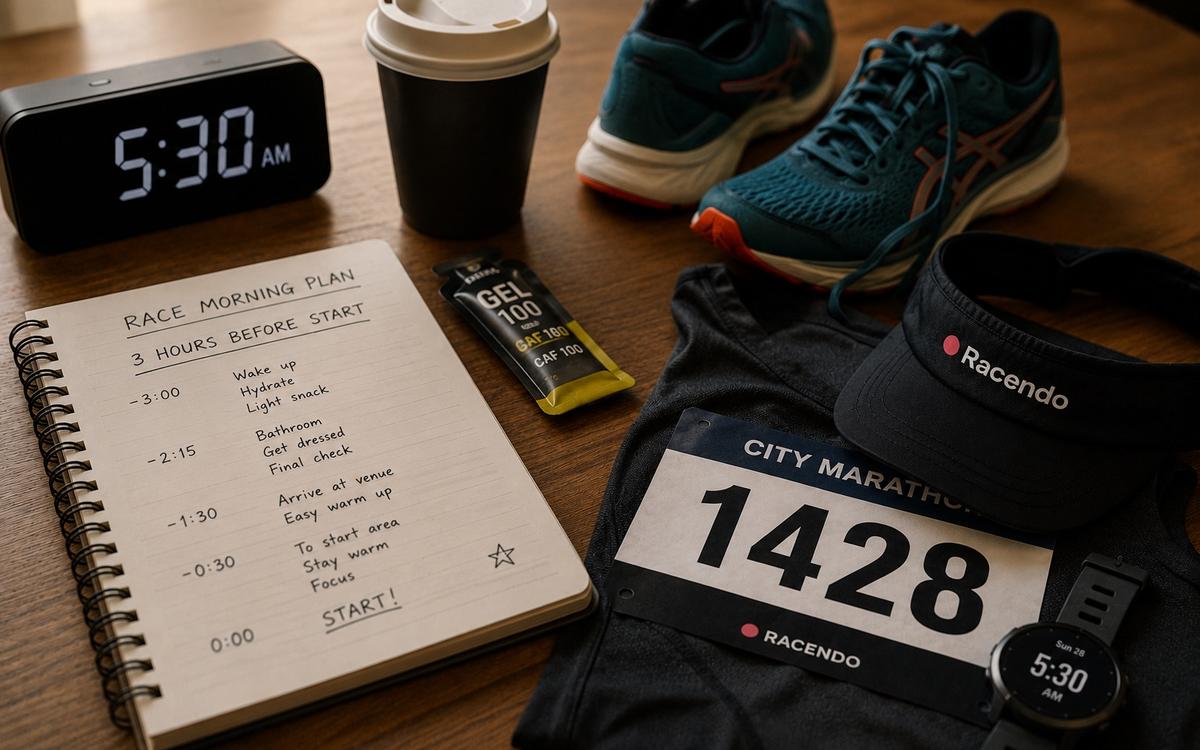
Race morning is not the time to create a plan.
It is the time to follow one.
The training is done. The kit should already be ready. The race details should already be saved. The goal should already be clear. What matters now is execution.
Still, race morning can feel surprisingly busy.
There is breakfast to eat, a bag to pack, transport to manage, toilets to find, nerves to control, warm-up decisions to make and a start line to reach on time.
A good race morning plan removes as many decisions as possible before the day begins.
This guide gives a practical three-hour race morning structure runners can adapt for different distances, start times and race sizes.
Why race morning matters
Race morning will not create fitness.
But it can protect the fitness already built.
A rushed morning can create stress before the race even starts. A late arrival can lead to poor warm-up, missed bag drop, skipped toilet stops or a panicked start. An untested breakfast can create stomach problems. A forgotten gel can change the fueling plan. A dead watch can become an unnecessary distraction.
Most race morning mistakes are not dramatic.
They are small things that add pressure.
A better plan helps the runner avoid them.
Race morning should answer five simple questions:
- When do I wake up?
- What do I eat and drink?
- What do I wear and carry?
- How do I get to the start?
- What do I do in the final hour?
Once those answers are clear, the morning becomes much easier to manage.
Three hours before the start
For many races, waking up around three hours before the start gives enough time to eat, get ready, travel and arrive without rushing.
This is not a universal rule. Some runners need more time. Some local races may need less. Early starts, destination races, large city marathons and complicated transport usually require a bigger buffer.
Three hours before the start, the goal is simple.
Wake up calmly and start the routine you already planned.
Useful first steps:
- Turn off the alarm and avoid rushing immediately
- Drink a small amount of water
- Eat the planned breakfast
- Check how the body feels without overanalyzing it
- Put on race kit or prepare to change later
- Confirm the weather one final time
- Check transport timing
- Keep the morning quiet and predictable
Do not start making major changes now.
If the kit, breakfast, fueling and race plan were chosen during race week, trust the plan unless there is a clear reason to adjust.
What to eat before the race
Race morning breakfast should be familiar.
The best breakfast is usually not the most "perfect" one. It is the one the runner has tested and knows they can tolerate.
For longer races, breakfast often needs to provide enough energy without feeling heavy. For shorter races, it may be lighter. The exact meal depends on the runner, race distance, start time and personal preference.
Common race morning breakfast options include:
- Bagel or toast with honey or jam
- Oats or porridge
- Banana
- Rice cakes
- Cereal
- Energy bar
- Coffee if normally used
- Sports drink if already tested
- Water in normal amounts
Avoid choosing something new because it sounds more professional.
Race morning is not the time to test a new breakfast, new caffeine amount, new supplement or aggressive fueling idea.
If nerves make eating difficult, use something simple and familiar. The goal is not to force a huge meal. The goal is to start with energy and confidence.
What to drink before the race
Hydration matters, but overdoing it can create problems.
A good race morning hydration plan is usually calm and steady.
Drink enough to feel normal. Do not force excessive water just because the race is important.
A simple approach:
- Drink small amounts after waking
- Use coffee only if it is part of your normal routine
- Consider electrolytes only if tested before
- Avoid drinking large amounts right before the start
- Adjust slightly for heat, but do not panic
- Know where toilets are before entering the start area
For longer races, especially in warm conditions, the hydration plan should connect to the fueling plan.
Still, the most important rule is simple.
Do not do something on race morning that has never worked in training.
Two and a half hours before the start
Around two and a half hours before the start, focus on getting dressed and checking essentials.
The goal is to avoid repeated checks later.
Use the kit list you prepared the day before.
Race kit checklist:
- Race shoes
- Race socks
- Shorts, tights or race bottoms
- Singlet, T-shirt or race top
- Sports bra if needed
- Bib attached correctly
- Race belt or pins
- Watch charged
- Heart rate strap if used
- Fuel packed
- Cap or sunglasses if needed
- Gloves or arm sleeves if needed
- Anti-chafe product applied if normally used
- Blister protection applied if normally used
- Warm layer for before the start
- Post-race clothes packed if needed
This is also the right moment to check anything that depends on weather.
If it is colder than expected, add a warm layer for waiting.
If it is raining, decide whether to wear a throwaway cover, cap or light layer before the start.
If it is hot, review the plan for effort, hydration and sun protection.
Make these decisions once. Then move on.
Two hours before the start
Two hours before the start is usually when the practical movement begins.
For a large race, this may mean leaving the hotel, catching public transport, walking toward the start area or joining the flow of runners.
For a smaller local race, this may mean driving, parking or preparing to leave home.
The main rule is to arrive with more time than you think you need.
Large races often include:
- Crowded public transport
- Road closures
- Security checks
- Long toilet queues
- Bag drop lines
- Separate start waves
- Long walks to corrals
- Confusing start zones
Small races can be simpler, but they still require timing.
Useful things to confirm before leaving:
- Phone
- Watch
- Bib
- Fuel
- ID if needed
- Bag drop label if used
- Transport ticket
- Race confirmation or QR code
- Hotel key or house key
- Payment card
- Warm layer
- Post-race meeting point
Once you leave, the plan should be simple enough to follow without searching through emails.
Ninety minutes before the start
Around ninety minutes before the start, you should ideally be close to the race area or moving toward it.
This is where the morning often becomes more intense.
There are more runners. The atmosphere builds. Announcements begin. Toilets get busy. It becomes harder to think clearly.
This is why preparation matters.
At this point, focus on three tasks:
- Get into the right area
- Complete practical tasks early
- Keep your energy calm
Do not waste energy walking around without purpose.
If you need bag drop, find it early.
If you need the toilet, join the queue early.
If you need to meet someone, choose a specific location.
If you need to change layers, do it before the final rush.
The goal is to avoid needing five things in the final 20 minutes.
Bag drop
Bag drop can take longer than expected.
Do not leave it too late, especially at large races.
Before using bag drop, make sure you have kept everything needed for the race itself.
Keep with you:
- Fuel
- Watch
- Phone if carrying it
- Any required medication
- Gloves, cap or sunglasses if needed
- Throwaway layer if using one
- Toilet paper or small tissue if needed
- Anything required for the start area
Put in the bag:
- Dry clothes for after the finish
- Comfortable shoes
- Extra layer
- Recovery snack
- Water bottle if wanted after
- Towel if useful
- Power bank if not carried
- Personal items you do not need during the race
After dropping the bag, do not keep wondering whether something was forgotten. That is why the checklist exists.
Toilet planning
Toilet planning is not glamorous, but it matters.
For big races, queues can be long. Start areas can be crowded. The final 30 minutes can become stressful if this is not handled early.
A practical approach:
- Use the toilet before leaving accommodation if possible
- Identify toilets when arriving at the start area
- Join the queue earlier than feels necessary
- Do not wait until the final minutes
- Know when you need to move to the corral
- Accept that some waiting is part of race morning
Nerves can also affect the stomach.
That is normal.
A familiar breakfast, calm timing and early arrival usually help.
One hour before the start
One hour before the start, the main logistics should be mostly complete.
The bag is dropped. The toilet queue is handled or planned. The start area is understood. The runner knows where to go.
Now the focus shifts to readiness.
Depending on the race distance and personal preference, this may include warming up, light mobility, short strides or simply staying warm and calm.
A one-hour checklist:
- Confirm start wave or corral
- Check watch is ready
- Take planned fuel if needed
- Sip water if needed
- Remove unnecessary layers only when appropriate
- Start warm-up if planned
- Review the first part of the race plan
- Move closer to the start area
The final hour should feel intentional.
If it feels chaotic, simplify.
The most important thing is to be in the right place, with the right kit, at the right time.
Warm-up
The right warm-up depends on the race.
A 5K usually needs more warm-up than a marathon. A marathon warm-up may be shorter because the race itself is long and the early kilometers can be controlled.
A simple warm-up for shorter races might include:
- 10 to 15 minutes of easy jogging
- Light mobility
- A few relaxed strides
- Enough time to calm down before the start
A simple warm-up for longer races might include:
- Easy walking or light jogging
- Gentle mobility
- Short relaxed movements
- Staying warm before the start
Do not copy someone else's warm-up at the start line.
Use what you know works.
The warm-up should prepare the body, not tire it.
Thirty minutes before the start
Thirty minutes before the start, the race becomes real.
This is when many runners start checking everything repeatedly.
Try not to.
Instead, follow a short final checklist:
- Enter the correct start area
- Check shoes and laces
- Confirm fuel is accessible
- Start watch activity screen if helpful
- Take final planned sip or fuel
- Remove throwaway layer only when ready
- Breathe slowly
- Review the first kilometer strategy
- Stay patient
This is also the moment to manage the emotional pull of the start.
Music, crowds, announcements and other runners can make the race feel faster before it begins.
Remember the plan.
The first part of the race should usually feel controlled.
The first kilometer starts before the start
Many race mistakes begin before the line is crossed.
The runner gets excited, moves too close to faster runners, starts the watch in a panic, surges around people, chases an early pace or treats the first kilometer like proof of fitness.
A good race morning plan includes the first kilometer.
Decide before the start:
- Will you run the first kilometer slightly slower?
- Will you ignore GPS pace if buildings affect signal?
- Will you use effort instead of pace early?
- Will you avoid weaving through crowds?
- Will you let other runners go?
- Will you check pace only after settling?
The first kilometer should support the race, not satisfy nerves.
This is especially important in longer races.
Starting controlled is not weakness. It is discipline.
What to do if something goes wrong
Even good race morning plans can face problems.
The goal is not perfection. The goal is calm problem solving.
If you are running late:
- Focus only on the essentials
- Do not waste time on non-critical tasks
- Get to the start safely
- Adjust warm-up if needed
- Start calmly instead of trying to "make up" stress
If the weather changes:
- Adjust clothing if possible
- Adjust expectations if needed
- Run by effort where pace becomes misleading
- Protect yourself from cold, heat or rain before the start
If you forget something:
- Decide whether it is essential
- Solve it only if there is time
- Do not let one missing item control the entire race
If nerves are high:
- Slow your breathing
- Focus on the first simple action
- Return to the plan
- Remember that nerves are normal
Most race morning issues are manageable if the runner stays calm.
What not to do on race morning
Race morning is a bad time for experiments.
Avoid:
- New breakfast
- New shoes
- New socks
- New fuel
- New caffeine strategy
- New warm-up routine
- New pacing goal
- New race kit
- Last-minute hard running
- Rechecking every prediction
- Comparing plans with everyone else
- Standing around too long without warm clothing
- Starting faster because the crowd does
The safest race morning is usually the one that feels familiar.
That does not mean boring.
It means tested.
A simple three-hour race morning timeline
Use this as a starting point and adjust it for your race.
Three hours before start:
- Wake up
- Eat planned breakfast
- Drink normally
- Check weather once
- Begin calm routine
Two and a half hours before start:
- Get dressed
- Check kit
- Apply anti-chafe or blister protection if used
- Pack final items
- Confirm transport
Two hours before start:
- Leave accommodation or home
- Follow planned transport route
- Keep race confirmation and start details accessible
Ninety minutes before start:
- Arrive near race area
- Find toilets
- Locate bag drop
- Move with purpose, not panic
One hour before start:
- Drop bag if needed
- Take planned fuel or drink if needed
- Start warm-up or stay warm
- Review race plan
Thirty minutes before start:
- Enter start area
- Check laces and watch
- Keep fuel accessible
- Stay calm
- Focus on the first kilometer
Start:
- Begin controlled
- Let the race come to you
- Follow the plan before reacting emotionally
Final thought
A good race morning does not happen by accident.
It is prepared before the alarm rings.
The goal is not to control every detail. Races will always include uncertainty. The goal is to remove the avoidable problems so the runner can handle the real race with a clear head.
Wake up with a plan.
Eat what you know.
Wear what you tested.
Arrive with time.
Start with control.
That is enough.
Race morning should not feel like a scramble.
It should feel like the final step in a preparation process that already makes sense.