
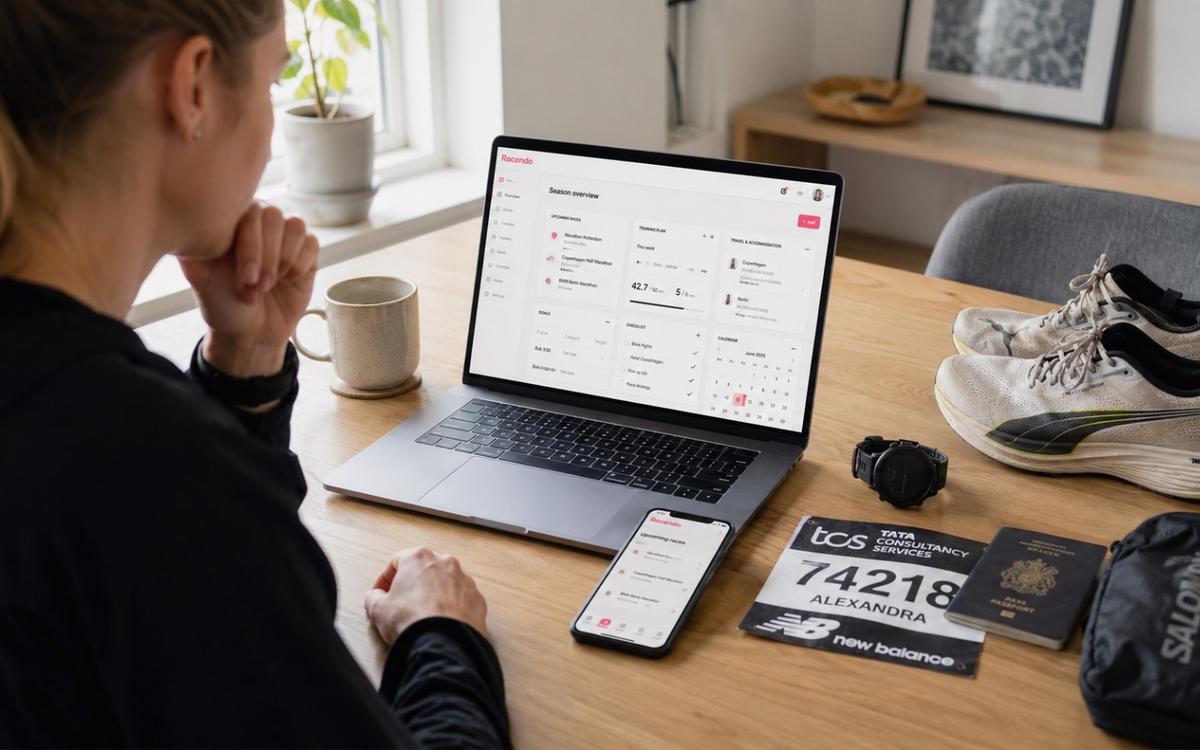
Most runners do not start a new race season by thinking about systems.
They start with excitement.
A race opens for registration. A friend sends a link. A ballot result arrives. A marathon weekend starts to sound possible. A half marathon becomes the next target. A trail race looks too good to ignore.
Then the planning begins.
One race goes into the calendar. The confirmation email stays in the inbox. The hotel booking is saved somewhere else. Travel options are checked later. Costs are remembered vaguely. Training starts in one app. Notes are added in another. A spreadsheet appears because there is no obvious place to keep everything together.
At first, it works.
Then the season grows.
One event becomes three. A goal race gets added. A recovery race is moved. A ballot is pending. A travel weekend needs decisions. A training plan changes. A registration email is hard to find. Costs are higher than expected. Suddenly, the runner is not just training.
They are managing a season.
A race season is more than a list of events
It's easy to think race planning is simply about choosing races and adding them to a calendar.
That is only the visible part.
A real race season includes decisions, commitments, deadlines, logistics, money, preparation, recovery, and personal goals. It includes the practical things around each race and the way those races affect each other.
A 10K in March may be a fitness check.
A half marathon in May may be a stepping stone.
A marathon in September may be the main target.
A trail race in November may be the reward.
Each race has a role. Each one affects the next. Each one adds something to the season.
That is why a simple calendar view is not enough. It can show when something happens, but it does not explain what that race means, what it requires, what it costs, or how it fits into the bigger plan.
Spreadsheets solve one problem and create another
Spreadsheets are often the first tool runners use when planning more than one event.
They are flexible. They are familiar. They can hold dates, links, prices, notes, and status fields. They feel like control.
But spreadsheets quickly become passive storage.
They do not understand training progress.
They do not know whether a race is an A-race, a preparation race, or a fun race.
They do not connect the event to readiness.
They do not remind the runner that accommodation still needs to be booked.
They do not know that a confirmation email contains important details.
They do not explain whether the season is becoming too expensive, too crowded, or too demanding.
They also require constant manual work. Every update depends on the runner remembering to add, change, or check something.
That is the real problem. A spreadsheet can store a plan, but it does not help manage the plan.
The missing layer between training and race day
Most runners already have tools for training.
They may track runs with a watch. They may sync activities from Strava. They may follow a training plan. They may look at pace, heart rate, distance, effort, and progress.
That data matters.
But training data alone does not manage the full race journey.
A runner preparing for a race also needs to know what is happening around the training. Travel. Costs. Documents. Race information. Start times. Expo details. Weather. Kit choices. Accommodation. Local transport. Recovery time. Future races.
These things may not appear in a workout summary, but they still shape the race experience.
That is where many runners lose control. Not because they are unmotivated. Not because they lack discipline. But because the practical side of racing is scattered across too many places.
Race season planning should connect the physical preparation with the real-world preparation.
Every race should have a purpose
A strong season usually has structure.
Not every race can be the main goal. Not every race should be treated the same way. Some races are there to test fitness. Some are part of a bigger series. Some are social. Some are training benchmarks. Some are bucket-list goals.
Runners often know this instinctively, but the plan rarely reflects it clearly.
A better race season starts by defining the role of each event.
An A-race is the main target. It is the race where the training cycle, travel decisions, and preparation matter most.
A B-race supports the bigger goal. It may be used to test pacing, nutrition, confidence, or current fitness.
A C-race is lower pressure. It may be social, local, fun, or part of keeping momentum.
Once each race has a purpose, the season becomes easier to understand.
The question is no longer only, "Which races am I doing?"
The better question is, "Why is each race in the plan?"
Costs should be visible before they become a surprise
Race entries are often the smallest part of the total cost.
A season can include flights, hotels, trains, meals, gear, insurance, local transport, race photos, expo purchases, and recovery expenses. Even local races can add up when there are enough of them.
Many runners only see the true cost after the season is already underway.
That makes planning harder. It can also turn an exciting season into something stressful.
A better approach is to track estimated and actual costs from the beginning.
What is already paid?
What still needs to be booked?
Which races are fixed commitments?
Which ones are still optional?
Where is the season becoming more expensive than expected?
This does not mean every runner needs to turn racing into financial administration. It simply means the full picture should be visible early enough to make better decisions.
Confirmation emails should become part of the plan
A race confirmation email is not just a receipt.
It can include registration details, bib pickup information, start times, race rules, participant numbers, payment confirmation, links, documents, QR codes, and other details that may matter later.
The problem is that these emails are usually buried in the inbox.
When race week arrives, the runner has to search for information that should already have been part of the plan.
This is one of the reasons Racendo is built around the idea that race information should be captured and organized, not forgotten.
When the important details are connected to the race itself, the runner can spend less time searching and more time preparing.
Readiness should be part of race season planning
Race season planning is not only about logistics.
It is also about whether the plan still makes sense.
A goal that looked realistic in January may need adjustment by April. A missed training block may not ruin the season, but it may change the target. A strong period of progress may open up new possibilities. A crowded calendar may create more fatigue than expected.
This is where readiness becomes useful.
Readiness should not be reduced to a single prediction. It should help runners understand the direction they are moving in.
Is the goal still realistic?
Is training moving in the right direction?
Are skipped sessions becoming a pattern?
Is recovery keeping up with the season?
Does the next race still fit the bigger plan?
A good race season is not fixed forever. It adapts.
Racendo is built for the full race journey
Racendo is not just a place to list races.
It is designed to help runners bring the full race journey together.
Events, training, costs, documents, race information, goals, and readiness belong in the same planning environment because they affect each other.
A race should not live in one calendar, the confirmation email in another inbox, the budget in a spreadsheet, the goal in a note, and the training progress in a separate app.
That creates friction.
Racendo helps reduce that friction by giving runners a clearer view of what they are working toward and what needs attention next.
It supports the practical side of race preparation while keeping the runner focused on the bigger goal.
Racendo Coach adds context to the plan
Planning is easier when the system can help interpret what is happening.
Racendo Coach is designed to support that role.
It can help turn scattered information into practical guidance. It can highlight what may need attention. It can help explain whether a goal still looks realistic. It can support planning decisions without taking control away from the runner.
The runner remains in charge.
The value is not that AI makes every decision. The value is that the runner has better context when making decisions.
That matters across a full season, where the right adjustment at the right time can make the difference between a controlled plan and a stressful one.
A better way to plan a race season
A strong race season does not need to be complicated.
It needs to be clear.
The runner should know which races matter most, what each race is for, what has already been paid, what still needs to be booked, what documents are important, how training is progressing, and whether the original goal still makes sense.
That is difficult when everything is spread across apps, inboxes, notes, and spreadsheets.
It becomes easier when the season is treated as one connected journey.
That is the shift Racendo is built around.
Not just tracking runs.
Not just listing events.
Not just storing confirmations.
But helping runners understand and manage the full path from sign-up to finish line.
Start with the season, not the spreadsheet
A spreadsheet can hold information.
A race season needs more than that.
It needs structure, context, visibility, and the ability to adapt.
For runners planning one race, this can remove stress.
For runners planning several races, it can change the entire experience.
The goal is not to make race planning feel like administration. The goal is the opposite.
Less searching.
Less guessing.
Less last-minute panic.
More clarity.
More confidence.
A better race season starts when everything around the race finally connects.